

Hi, I’m Tom Smith, an osteopath and naturopath based in Riccall, between York and Selby. In this post, I want to explain why Swiss balls are such a valuable tool — not just in rehab and exercise programmes, but also in everyday life.
Swiss balls often look simple (or even gimmicky), but when used correctly they can play a powerful role in improving movement quality, posture, core function and overall physical resilience.
For more detail, feel free to watch my video from my you tube channel bellow:
What Is a Swiss Ball?
A Swiss ball (also known as a stability ball or exercise ball) is a large inflatable ball often found in a gym or leisure facility. There is often a Swiss ball aka a birthing ball found in the maternity ward of the hospital and has been used for ladies during pregnancy and labour a low-cost and effective tool that aids comfort, reduces pain, and helps with the progression of labor through movement. Fit balls or Swiss balls are great for:
- Exercise and rehabilitation
- Improving balance and coordination (with the right people)
- Relaxation
- Core and postural training
- Stretching and mobility work
- Even sitting at a desk instead of a chair
I love how versatile it is, especially when exercising.

Why I Use Swiss Balls So Often
Before becoming an osteopath, I worked for many years as a health and fitness professional. I qualified as a personal trainer back in 2004 and have used Swiss balls extensively — both in my own training and with clients.
Over the years, I’ve seen how effective they can be when used properly.
A Swiss ball can help with:
- Stretching and mobility
- Core stability and core function (not just strength)
- Improving posture
- Sports-specific conditioning
- Relaxation and breathing
- Home exercise programmes where equipment is limited
If you exercise at home and don’t have much kit, a Swiss ball is one of the most useful pieces of equipment you can own.
Swiss Balls and the Nervous System
One of the most important — and often overlooked — benefits of using a Swiss ball is how it stimulates your nervous system.
Many gym machines (chest press, lat pulldown, pec deck, etc.) provide a lot of external support. The moment you sit on them, many of your stabilising and postural muscles switch off.
A Swiss ball does the opposite. Because it’s round and unstable, your body has to constantly make small adjustments to keep you upright.
These situations activate what we call tilting and righting reflexes — essential for real-world movement.
Preparing the Body for Real Life (and Sport)
Even if you don’t play sport, your body still needs to respond to unpredictable environments such as standing on a moving bus or escalator at the airport.
Swiss ball training can also help prepare for:
- Slips and trips
- Uneven ground
- Sudden movements
- Everyday balance challenges
And if you do take part in sports like:
- Surfing
- Skiing
- Skateboarding
- Field or court sports
Swiss ball work can be an excellent way to improve control, balance, and coordination in a safe, progressive way.

Swiss Balls and Core Training: Range of Motion Matters
A lot of people do crunches or sit-ups on the floor at home. The problem is that the floor limits your movement.
When you lie on the floor:
- You only move until you hit the ground
- Your trunk range of motion is restricted
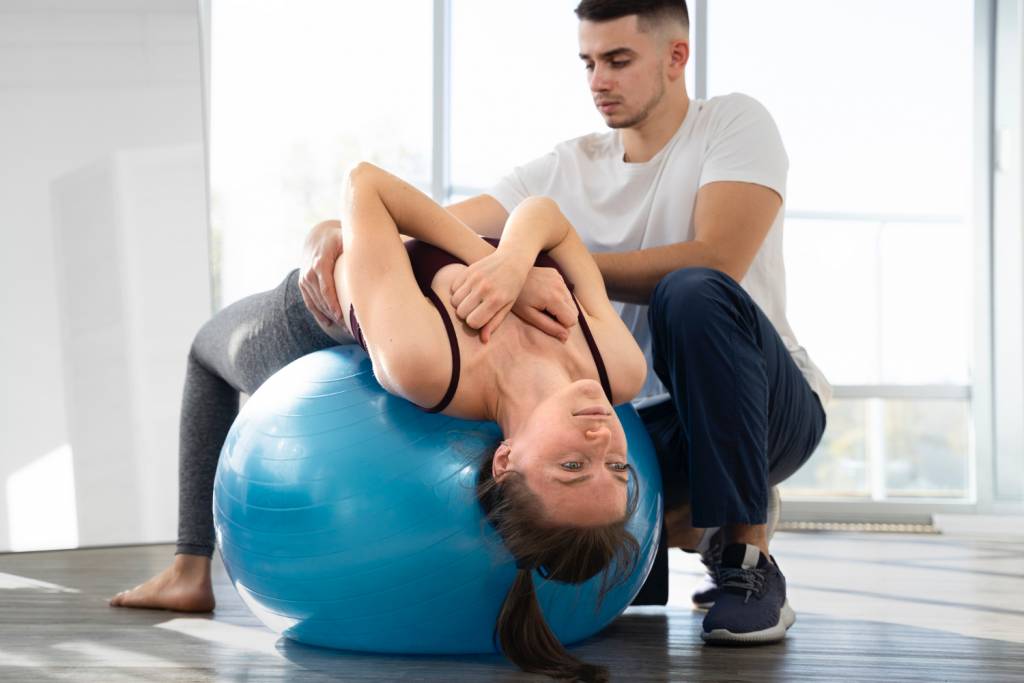
With a Swiss ball (assuming your spine is healthy and mobile), you can:
- Arch back over the ball and gain an extra 20–30 degrees of trunk movement
Think of it like a bicep curl:
If you only curl halfway up and halfway down, you never fully strengthen the muscle. Full range of motion builds better strength, control, and resilience.
The same principle applies to your trunk and core.
Who Should (and Shouldn’t) Use a Swiss Ball?
Swiss balls are suitable for many people, but they’re not appropriate for everyone in every situation.
With supervision, they can be used by:
- Beginners
- Older adults
- People in rehabilitation
However, caution is needed if:
- You have no exercise experience
- Your balance is significantly compromised
- You’ve been told you have very brittle bones
- You’re unsure how to use the ball safely
In these cases, Swiss ball exercises may still be appropriate — but only under supervision.
If you’re working with a personal trainer, physiotherapist, or osteopath, speak to them about whether Swiss ball exercises are suitable for you and how to integrate them safely.
Final Thoughts
Swiss balls are far more than a fitness trend.
Used correctly, they can:
- Improve posture and balance
- Enhance core function
- Stimulate the nervous system
- Support rehabilitation
- Prepare the body for real-life movement
If you’d like to know whether a Swiss ball could help you — or how to use one safely as part of a personalised plan — I’d be happy to help.
Bookings are available online at: www.evolveosteopathy.co.uk
Thanks for reading, and I’ll see you in the next one.
— Tom Smith